
Queridos hijos,
Quizás hayáis notado que, últimamente, mi locuacidad epistolar anda de capa caída.
Sí, hijos míos, así ha sido. ¿Para qué negarlo? ¿Y por qué?, os preguntaréis… La causa, debo reconocer, ha sido pretender afrontar retos quizás demasiado elevados.
Así es. Dediqué algunas tardes al análisis de la última obra de ese Harari que tanto apreciáis y lo hice con la santa intención de mostrar su escaso fundamento, apoyándome en las verdades perennes alcanzadas por la filosofía clásica… Pero, de algún misterioso modo, la colina de la argumentación que ¡ingenua de mí! comencé a remontar muy alegremente devino pronto montaña escarpada y acabó pareciéndome el inexpugnable Himalaya. Sí, lanzar afirmaciones requiere a veces poco esfuerzo, pero desmontarlas resulta siempre harto trabajoso.
Exhausta y cabizbaja, decidí dejar el intento en temporal barbecho y, para salir del páramo que me atrapaba y como antídoto contra mi agotamiento, pensé en desempolvar para vosotros una anécdota liviana e intrascendente que en nuestra familia ha pasado de generación en generación, buscando que, al tiempo de transmitírosla, surtiera también un efecto refrescante en mi mente fatigada.
Vamos allá.
Quizás sabéis que en las dos ramas de vuestra familia manchega siempre hubo afición y maestría en la elaboración de madalenas, roscos, flores fritas… Vuestra bisabuela Casilda, madre de vuestra abuela Águeda y nieta de la protagonista de esta pequeña historia, era conocida por su buena mano con los dulces. Y por la parte de la familia de vuestro abuelo Nicolás, su hermana Carmen (tan querida por él) era célebre en los contornos por la exquisitez de la bollería que elaboraba en la panadería familiar. Recuerdo las tardes que pasaba con mi tía Carmen haciendo «cajas» para las madalenas que ella preparaba y que después introducía en aquel horno de leña que impregnaba la casa, así como mi memoria, con un aroma maravilloso.
Sabéis (porque creo que vuestra abuela Águeda os había hecho esa vieja broma, tan antigua que sospecho que en nuestra familia se remonta al Neolítico) que, una vez levantadas las claras a punto de nieve, era costumbre que la repostera demostrara su confianza en la firmeza de su elaboración, volteando el lebrillo sobre la cabeza de algún niño que por allí pasara. La criatura (casi podemos verla ¿a que sí?) sostendría entre risas la tensión del momento… «¿aguantará? ¿no aguantará?»… Cerraría los ojos, encogería los hombros como para esconder la cabecita, temiendo en parte la ducha de merengue pero demostrando con su sonrisa que mayormente confiaba en la pericia de la pastelera.
Pero metámonos en harina, nunca mejor dicho. Sería esto hacia el año del Señor de 1880. Vuestra trastatarabuela (o tataratatarabuela, que también así se puede denominar) Celedonia Cesárea y otras mujeres de la familia estaban en la cocina en animada compañía preparando una hornada de madalenas y roscos que después llevarían a cocer a la panadería local, pues tal era la costumbre en aquel tiempo: bollería y panes se preparaban en casa y después se pagaba al panadero por el uso de su horno. Esta costumbre se mantuvo hasta bien entrada la posguerra.
Prosigo. Aquel día, en alguno de aquellos enormes lebrillos que todavía se conservan en la casa de Villavaliente, las mujeres separaron las claras de 24 huevos y reservaron las correspondientes yemas para su posterior incorporación. Se encargaba de montar las claras la misma Celedonia. Batía y batía con gran denuedo y tesón, y en un momento dado, con confianza prematura, quiso hacer la consabida broma y, al no haber por allí niño alguno, pensó en demostrar su pericia sobre ella misma. Parece que la estoy viendo: cogiendo el lebrillo con una sonrisa confiada en su rostro, anticipando el triunfo, volteando el recipiente y (¡oh catástrofe!) ¡derramándose todo el merengue sobre su cabeza!
Ay Señor…
Como siempre sucede en estos casos, los presentes reaccionaron según su naturaleza más íntima: unos se carcajearon inmisericordes, otros se azoraron, y a la infortunada, arruinados simultáneamente su momento estelar y su aspecto, se le saltaban las lágrimas mientras bregaba por quitarse de encima el blanco elemento espumoso…
En ese momento, intrigado por la escandalera, asomó por la puerta su sensato marido Joaquín, que, tras ayudar a Celedonia a limpiarse, acertó a decir las palabras que lo han preservado en la memoria familiar durante este último siglo y medio: «Venga, traed dos docenas de huevos más y aquí no ha pasado nada». Y entonces esa liberalidad tenía más mérito que ahora, ya que dos docenas de huevos no eran poca cosa: no producían tanto las gallinas domésticas y todo era medido y racionado y nada sobraba. Y una se imagina a aquellas vivarachas comadres, movilizadas con las palabras justas, haciendo lo que se tenía que hacer…
Cuando escuché por primera vez esta historia me reí al constatar que uno nunca sabe cómo va a pasar a la posteridad. Ni siquiera si va a conseguirlo, en realidad… ¡Ay, sí!… En la vida podemos pontificar solemnemente (vuestra madre jamás, ya lo sabéis) y, generalmente, de eso a los cinco minutos nada queda. Sin embargo una frase espontánea y banal puede pasar de generación en generación. Misterios misteriosos del Señor…
Pero, sí. Es bonito que de uno quede el recuerdo de su proceder animoso ante los percances y disgustos. Muchas veces, a la vista de ilusiones que acaban en desaguisado, he intentado traer a mi ánimo la actitud de vuestro trastatarabuelo Joaquín y me he dicho: «Ea. No pasa nada. Volvamos a empezar». Porque es maravilla propia de lo humano que el recuerdo de la acción sabia de un ancestro actúe para fortalecer la propia virtud en el presente.
Sí. Yo también volveré a empezar mi refutación de Harari. Porfiaré en transmitiros argumentos que no caigan sobre mi cabeza por elaboración descuidada. Lo haré aunque ese filosófico empeño no sea quizás tan importante como transmitir el recuerdo de aquella mañana lejana en que unas hacendosas mujeres prepararon dulces como para un regimiento y el juicioso Joaquín levantó el ánimo alicaído de su esposa bañada en veinticuatro claras montadas (casi) al punto de nieve.
Os quiere,
Vuestra madre.
[Celedonia Cesárea Giménez Soler nació en Alatoz, Albacete, el 25 de febrero de 1846 y falleció el 12 de septiembre de 1929. Era hija de Antonio Giménez Ródenas y de Águeda Soler Gómez; nieta por línea paterna de Gabriel Giménez y Juana Ródenas y por vía materna de Juan Soler (natural de Quintanar del Río) y Antonia Gómez (natural de Motilla del Palancar).
Celedonia Cesárea se casó el día 2 de julio de 1871 con Joaquín López Hernández, que era del pueblo llamado Teresa en Valencia. Celedonia y Joaquín fueron los padres de vuestra tatarabuela Águeda (la madre de vuestra bisabuela Casilda, madre de vuestra abuela Águeda), y de sus dos hermanos José Antonio, que se ordenó sacerdote en 1901, e Ignacio, que emigró a Cuba siendo muy joven y, junto a su familia, visitaba España con frecuencia. Hubo otra hermana, una niña que se llamó Isabel-María y que era la mayor de todos pero que murió siendo muy niña.]
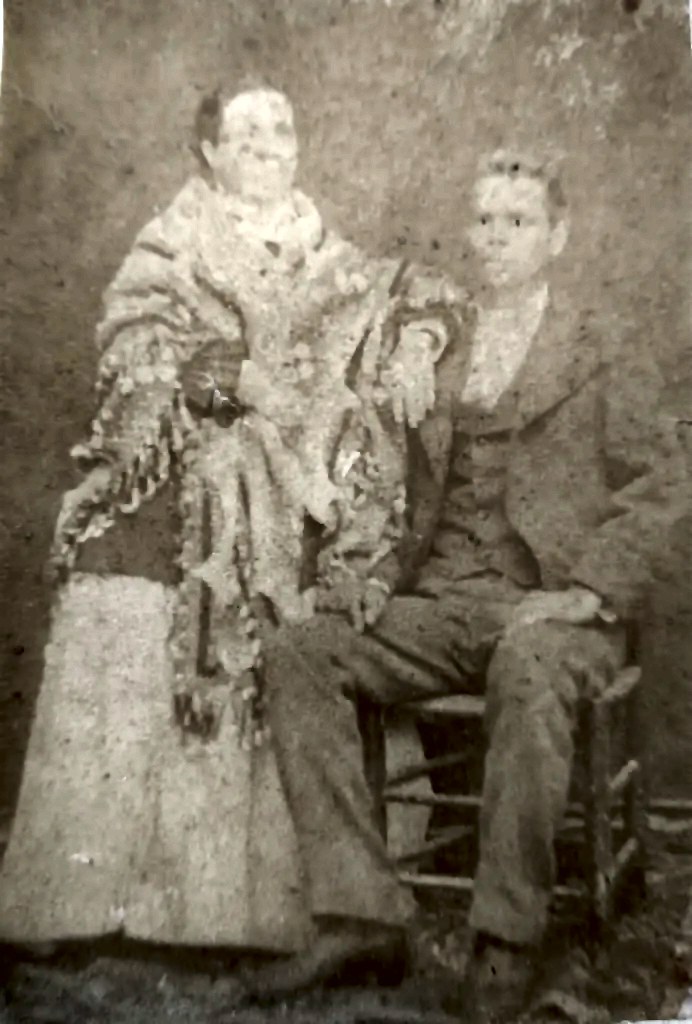
Celedonia y su marido Joaquín
Celedonia and her husband Joaquín
Celedonia et son mari Joaquín
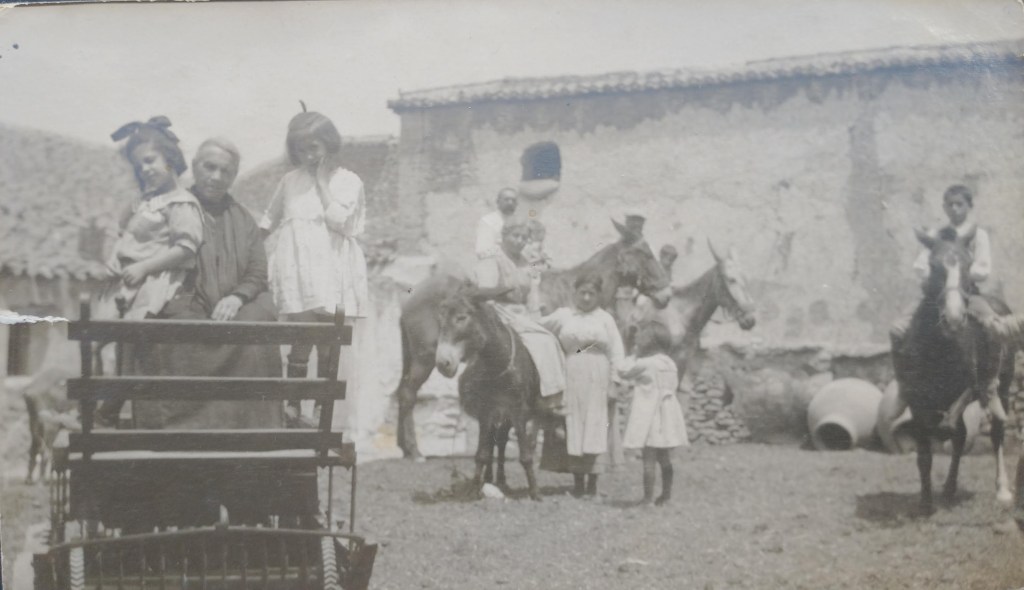
Casa familiar de Villavaliente. De izquierda a derecha: tía bisabuela Berta junto a su abuela Celedonia y su otra nieta, Celia, hija de Ignacio. En mula tatarabuela Águeda, detrás, a caballo, tatarabuelo Severiano.
The family house in Villavaliente. From left to right: great-great-aunt Berta, beside her grandmother Celedonia; another granddaughter, Celia, daughter of Ignacio. On a mule, great-great-grandmother Águeda; behind, on horseback, great-great-grandfather Severiano.
La maison familiale de Villavaliente. De gauche à droite : l’arrière-grand-tante Berta, à côté de sa grand-mère Celedonia ; une autre petite-fille, Celia, fille d’Ignacio. Sur une mule, l’arrière-arrière-grand-mère Águeda ; derrière, à cheval, l’arrière-arrière-grand-père Severiano.
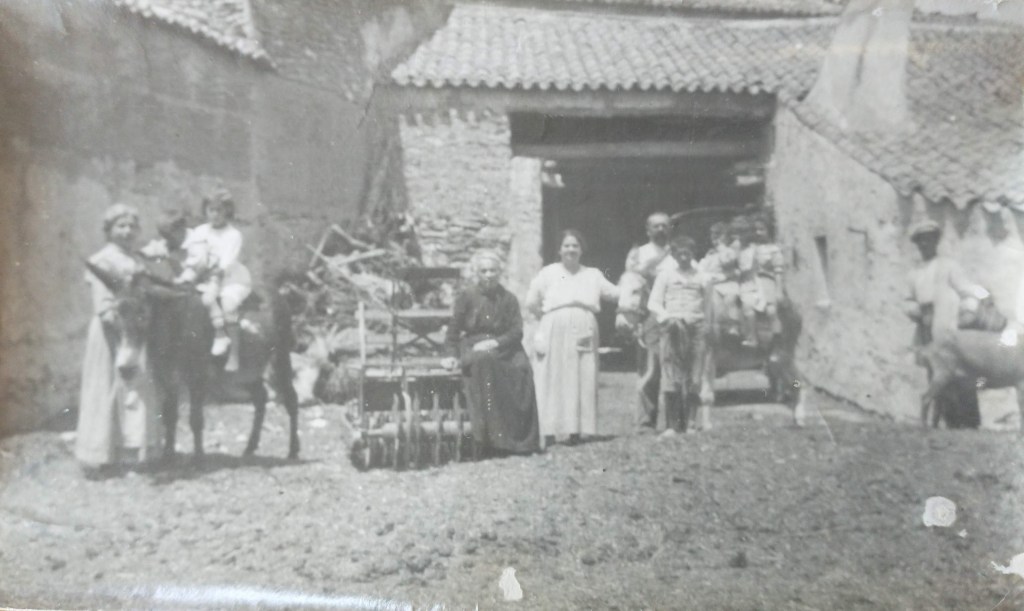
Casa familiar de Alatoz. A la izquierda, al lado del burro, la tatarabuela Águeda. Sentada en el arado, la trastatarabuela Celedonia; a su lado la esposa del tío tatarabuelo Ignacio, Luz; detrás el tatarabuelo Severiano. La chiquillería eran los hijos de los matrimonios Águeda-Severiano e Ignacio-Luz.
The family house in Alatoz. On the left, next to the donkey, great-great-grandmother Águeda. Seated on the plough, great-great-great-grandmother Celedonia; beside her, Luz, wife of great-great-great-uncle Ignacio; behind, great-great-grandfather Severiano. The swarm of children are the sons and daughters of the couples Águeda–Severiano and Ignacio–Luz.
La maison familiale d’Alatoz. À gauche, à côté de l’âne, l’arrière-arrière-grand-mère Águeda. Assise sur la charrue, l’arrière-arrière-arrière-grand-mère Celedonia ; à côté d’elle, Luz, épouse de l’arrière-arrière-grand-oncle Ignacio ; derrière, l’arrière-arrière-grand-père Severiano. La marmaille, ce sont les enfants des couples Águeda-Severiano et Ignacio-Luz.
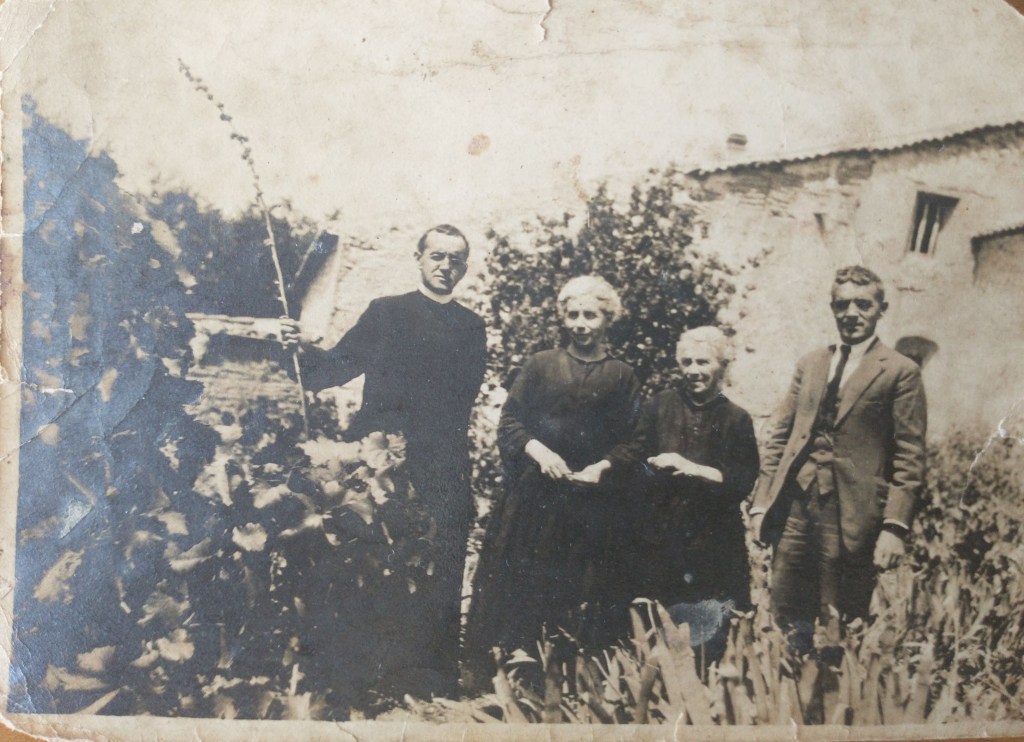
Casa familiar de Alatoz. Celedonia y sus tres hijos: el sacerdote José Antonio, Águeda e Ignacio.
The family house in Alatoz. Celedonia and her three children: the priest José Antonio, Águeda and Ignacio.
La maison familiale d’Alatoz. Celedonia et ses trois enfants : le prêtre José Antonio, Águeda et Ignacio.
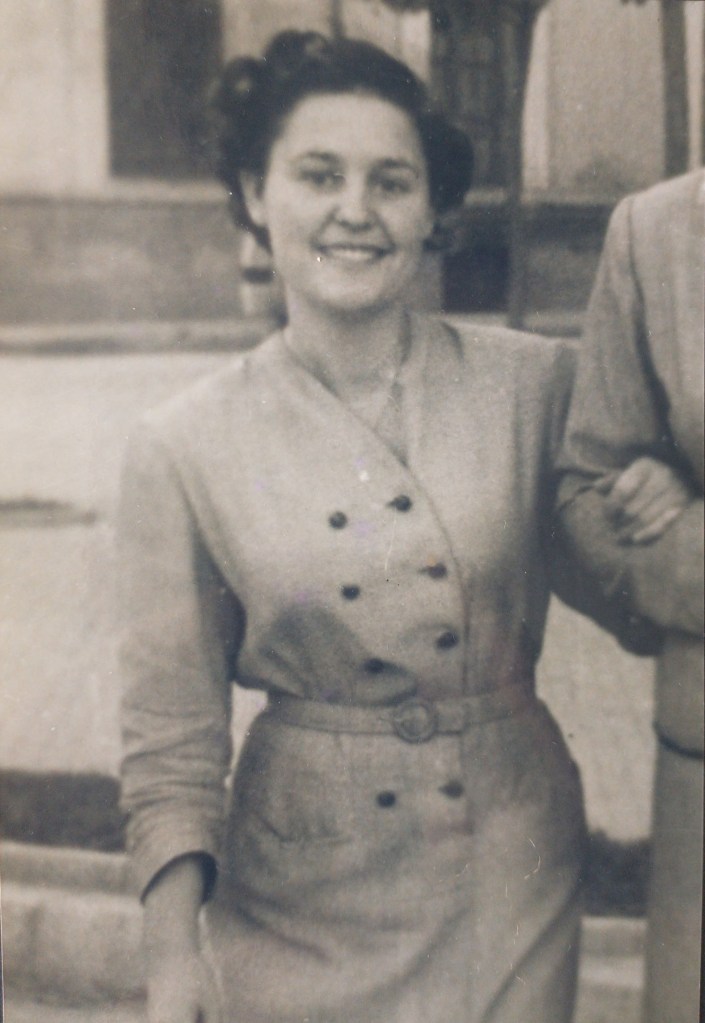
Tía abuela Carmen, la hermana soltera del abuelo Nicolás.
Great-aunt Carmen, grandfather Nicolás’s unmarried sister.
Grand-tante Carmen, la sœur célibataire du grand-père Nicolás.
………………………………………………………………………………………………………………………………………………………………………………………..
On Keeping Good Cheer in the Face of Setbacks
Dear children,
You may have noticed that, lately, my epistolary talkativeness has been flagging.
Yes, my dears, it has. Why deny it? And why, you will ask… The cause, I must admit, was taking on challenges perhaps too lofty.
So it is. I devoted a few afternoons to analysing the latest book by that Harari whom you so admire, with the holy intention of showing how slender its foundations are, leaning on the perennial truths reached by classical philosophy… But, by some mysterious means, the hill of argument that I (naive me!) had begun to climb so merrily soon became a steep mountain and ended up looking like the impregnable Himalayas. Yes, making assertions sometimes takes little effort, but dismantling them is always hard work indeed.
Exhausted and downcast, I decided to leave the attempt lying fallow for a while. To climb out of the wasteland that held me, and as an antidote to my weariness, I thought of dusting off for you a light and inconsequential anecdote that has been handed down in our family from generation to generation. I hoped that, in passing it on to you, it might also have a refreshing effect on my tired mind.
Here we go.
You may know that on both branches of your family from La Mancha there was always a love of baking and a mastery of it: madalenas (little sponge cakes), roscos (ring-shaped pastries), fried flower pastries… Your great-grandmother Casilda, mother of your grandmother Águeda and granddaughter of the heroine of this little story, was known for her skill with sweets. And on the side of your grandfather Nicolás’s family, his sister Carmen (so dear to him) was famous throughout the surrounding countryside for the exquisite pastries she made in the family bakery. I remember the afternoons I spent with my aunt Carmen making paper «boxes» for the madalenas she prepared, which she then slid into that wood-fired oven that filled the house, and my memory too, with a marvellous aroma.
You know (because I believe your grandmother Águeda played that old joke on you, so old that I suspect it goes back in our family to the Neolithic) that, once the egg whites had been whipped to stiff peaks, it was the custom for the pastry cook to show her confidence in the firmness of her work by turning the lebrillo (a large earthenware basin) upside down over the head of some child who happened to be passing. The little one (we can almost see him, can’t we?) would hold, giggling, the tension of the moment… «Will it hold? Won’t it hold?»… He would shut his eyes and hunch his shoulders as if to hide his little head, partly fearing the shower of meringue but showing with his smile that he mostly trusted the baker’s skill.
But let us get down to flour, as the saying goes (never more aptly). This would have been around the year of Our Lord 1880. Your great-great-great-grandmother Celedonia Cesárea (with yet another «great» added, if you like, for the title can be stretched) and other women of the family were in the kitchen, in lively company, preparing a batch of madalenas and roscos that they would afterwards take to be baked at the local bakery. Such was the custom at that time: pastries and breads were prepared at home, and the baker was then paid for the use of his oven. This custom lasted well into the post-war years.
I go on. That day, in one of those enormous lebrillos that are still kept in the house in Villavaliente, the women separated the whites of 24 eggs and set aside the corresponding yolks to be added later. Celedonia herself was in charge of whipping the whites. She beat and beat with great vigour and tenacity, and at a certain moment, with premature confidence, she wanted to play the customary joke. As there was no child about, she thought of demonstrating her skill on herself. I can see her now: taking up the basin with a confident smile, anticipating triumph, turning the vessel over and (oh, catastrophe!) all the meringue pouring down over her head!
Oh, Lord…
As always happens in such cases, those present reacted according to their innermost nature: some laughed mercilessly, others were flustered, and the unfortunate woman, her starring moment and her appearance ruined at once, had tears springing to her eyes as she struggled to get the white, frothy stuff off herself…
At that moment, intrigued by the racket, her sensible husband Joaquín looked in at the door. After helping Celedonia clean herself up, he managed to say the words that have preserved him in the family memory for the last century and a half: «Come on, bring two dozen more eggs, and nothing has happened here.» And that generosity counted for more then than it would now, for two dozen eggs were no small matter: domestic hens did not lay so many, everything was measured and rationed, and nothing was left over. And one imagines those spirited goodwives, galvanised by just the right words, doing what had to be done…
When I first heard this story I laughed to realise that one never knows how one will go down to posterity. Nor even whether one will manage it at all… Ah, yes!… In life we may pontificate solemnly (your mother never, you know that) and, generally, five minutes later nothing remains. Yet a spontaneous, banal phrase can pass from generation to generation. Mysterious mysteries of the Lord…
But yes. It is lovely that of a person there should remain the memory of his spirited way of meeting mishaps and disappointments. Many times, faced with hopes that end in a mess, I have tried to call to mind the attitude of your great-great-great-grandfather Joaquín and said to myself: «Come on. Nothing has happened. Let’s start again.» For it is a marvel proper to the human that the memory of an ancestor’s wise action should strengthen our own virtue in the present.
Yes. I too shall start again on my refutation of Harari. I shall persevere in passing on to you arguments that will not fall on my head through careless preparation. I shall do so even though that philosophical endeavour may not be as important as handing on the memory of that distant morning when some industrious women prepared sweets enough for a regiment, and the judicious Joaquín lifted the drooping spirits of his wife, bathed in twenty-four egg whites whipped (almost) to stiff peaks.
With all my love,
Your mother.
[Celedonia Cesárea Giménez Soler was born in Alatoz, Albacete, on 25 February 1846 and died on 12 September 1929. She was the daughter of Antonio Giménez Ródenas and Águeda Soler Gómez; paternal granddaughter of Gabriel Giménez and Juana Ródenas, and maternal granddaughter of Juan Soler (a native of Quintanar del Río) and Antonia Gómez (a native of Motilla del Palancar).
Celedonia Cesárea married Joaquín López Hernández, from the town called Teresa, in Valencia, on 2 July 1871. Celedonia and Joaquín were the parents of your great-great-grandmother Águeda (mother of your great-grandmother Casilda, mother of your grandmother Águeda) and of her two brothers: José Antonio, who was ordained a priest in 1901, and Ignacio, who emigrated to Cuba while still very young and he and his family often visited Spain. There was another sister, a girl named Isabel-María, the eldest of all, who died when she was very small.]
…………………………………………………………………………………………………………………………………………………………………………………..
De la bonne humeur face aux contretemps
Mes chers enfants,
Vous avez peut-être remarqué que, depuis quelque temps, ma faconde épistolaire est en berne.
Eh oui, mes enfants, il en est ainsi. À quoi bon le nier ? Et pourquoi, vous demanderez-vous… La cause, je dois le reconnaître, tient à ce que j’ai voulu relever des défis peut-être trop élevés.
C’est ainsi. J’ai consacré quelques après-midi à l’analyse du dernier ouvrage de ce Harari que vous appréciez tant, dans la sainte intention de montrer le peu de fondement qu’il a, en m’appuyant sur les vérités pérennes atteintes par la philosophie classique… Mais, par on ne sait quel mystérieux détour, la colline d’argumentation que (naïve que j’étais !) j’avais commencé à gravir si allègrement devint bientôt une montagne escarpée et finit par m’apparaître comme l’inexpugnable Himalaya. Oui, lancer des affirmations demande parfois peu d’efforts, mais les démonter est toujours une rude besogne.
Épuisée et la tête basse, je décidai de laisser ma tentative en jachère pendant un temps. Pour sortir de la friche où je m’étais enlisée, et comme antidote à ma lassitude, je songeai à dépoussiérer pour vous une anecdote légère et sans conséquence qui, dans notre famille, s’est transmise de génération en génération. J’espérais qu’en vous la racontant, elle aurait aussi un effet rafraîchissant sur mon esprit fatigué.
Allons-y.
Vous savez peut-être que, dans les deux branches de votre famille de La Mancha, on a toujours aimé et maîtrisé l’art des madalenas (petits gâteaux moelleux), des roscos (couronnes de pâte sucrée), des fleurs frites… Votre arrière-grand-mère Casilda, mère de votre grand-mère Águeda et petite-fille de l’héroïne de cette petite histoire, était réputée pour sa main experte avec les douceurs. Et du côté de la famille de votre grand-père Nicolás, sa sœur Carmen (qu’il aimait tant) était célèbre à la ronde pour l’exquise pâtisserie qu’elle faisait dans la boulangerie familiale. Je me souviens des après-midi passés avec ma tante Carmen à fabriquer des « caissettes » pour les madalenas qu’elle préparait et qu’elle enfournait ensuite dans ce four à bois qui imprégnait la maison, et ma mémoire avec elle, d’un arôme merveilleux.
Vous savez (car je crois que votre grand-mère Águeda vous avait fait cette vieille plaisanterie, si ancienne que je soupçonne qu’elle remonte, dans notre famille, au Néolithique) qu’une fois les blancs montés en neige, la coutume voulait que la pâtissière démontre sa confiance dans la fermeté de sa préparation en retournant le lebrillo (grand bassin de terre cuite) sur la tête de quelque enfant qui passait par là. Le petit (nous pouvons presque le voir, n’est-ce pas ?) soutiendrait en riant la tension du moment… « Tiendra-t-elle ? Ne tiendra-t-elle pas ? »… Il fermerait les yeux, rentrerait les épaules comme pour cacher sa petite tête, redoutant un peu la douche de meringue mais montrant par son sourire qu’il faisait surtout confiance au savoir-faire de la pâtissière.
Mais entrons dans le vif du sujet, ou plutôt dans la farine, c’est le cas de le dire. Cela se passait vers l’an de grâce 1880. Votre arrière-arrière-arrière-grand-mère Celedonia Cesárea (ou quadrisaïeule, si l’on préfère) et d’autres femmes de la famille se trouvaient dans la cuisine, en joyeuse compagnie, à préparer une fournée de madalenas et de roscos qu’elles porteraient ensuite cuire à la boulangerie du village. Telle était la coutume en ce temps-là : les pâtisseries et les pains se préparaient à la maison, puis l’on payait le boulanger pour l’usage de son four. Cette coutume se maintint jusque bien avant dans l’après-guerre.
Je poursuis. Ce jour-là, dans l’un de ces énormes lebrillos que l’on conserve encore dans la maison de Villavaliente, les femmes séparèrent les blancs de 24 œufs et mirent de côté les jaunes correspondants pour les incorporer plus tard. C’était Celedonia en personne qui montait les blancs. Elle battait, battait, avec grande ardeur et ténacité, et à un moment donné, forte d’une confiance prématurée, elle voulut faire la plaisanterie rituelle. Faute d’enfant à portée de main, elle songea à démontrer son habileté sur elle-même. Je crois la voir : saisissant le lebrillo avec un sourire confiant, anticipant le triomphe, retournant le récipient et (ô catastrophe !) laissant toute la meringue se déverser sur sa tête !
Ah, Seigneur…
Comme toujours en pareil cas, les présents réagirent selon leur nature la plus intime : les uns éclatèrent de rire sans pitié, les autres se troublèrent, et la malheureuse, son heure de gloire et son apparence ruinées d’un seul coup, avait les larmes aux yeux en s’efforçant de s’ôter de dessus cet élément blanc et mousseux…
À ce moment, intrigué par le vacarme, son mari Joaquín, homme de bon sens, apparut à la porte. Après avoir aidé Celedonia à se nettoyer, il trouva à dire les paroles qui l’ont conservé dans la mémoire familiale pendant ce dernier siècle et demi : « Allons, apportez deux douzaines d’œufs de plus, et il ne s’est rien passé ici. » Cette libéralité avait alors bien plus de mérite qu’aujourd’hui, car deux douzaines d’œufs n’étaient pas rien : les poules domestiques ne pondaient pas autant, tout était mesuré et rationné, et rien n’était de trop. Et l’on imagine ces vives commères, mobilisées par les mots justes, faisant ce qu’il y avait à faire…
Quand j’entendis cette histoire pour la première fois, je ris en constatant qu’on ne sait jamais comment on passera à la postérité. Ni même si l’on y parviendra, en réalité… Ah, oui !… Dans la vie, nous pouvons pontifier solennellement (votre mère jamais, vous le savez) et, généralement, cinq minutes plus tard, il n’en reste rien. Pourtant, une phrase spontanée et banale peut se transmettre de génération en génération. Mystères mystérieux du Seigneur…
Mais oui. Il est beau que d’une personne demeure le souvenir de sa façon courageuse d’affronter les contretemps et les déboires. Bien des fois, devant des espoirs qui tournent au désastre, j’ai essayé de me remettre en l’esprit l’attitude de votre arrière-arrière-arrière-grand-père Joaquín et je me suis dit : « Allons. Il ne s’est rien passé. Recommençons. » Car c’est une merveille propre à l’humain que le souvenir de l’action sage d’un ancêtre serve à fortifier notre propre vertu dans le présent.
Oui. Moi aussi, je recommencerai ma réfutation de Harari. Je m’obstinerai à vous transmettre des arguments qui ne me retomberont pas sur la tête pour cause d’élaboration négligée. Je le ferai même si cette entreprise philosophique n’est peut-être pas aussi importante que de transmettre le souvenir de ce matin lointain où d’industrieuses femmes préparèrent des douceurs pour un régiment et où le judicieux Joaquín releva le moral abattu de son épouse, baignée dans vingt-quatre blancs d’œufs montés (presque) en neige.
Je vous aime,
Votre mère.
[Celedonia Cesárea Giménez Soler naquit à Alatoz, Albacete, le 25 février 1846 et mourut le 12 septembre 1929. Elle était la fille d’Antonio Giménez Ródenas et d’Águeda Soler Gómez ; petite-fille, du côté paternel, de Gabriel Giménez et de Juana Ródenas, et, du côté maternel, de Juan Soler (originaire de Quintanar del Río) et d’Antonia Gómez (originaire de Motilla del Palancar).
Celedonia Cesárea épousa, le 2 juillet 1871, Joaquín López Hernández, originaire du village appelé Teresa, dans la province de Valence. Celedonia et Joaquín furent les parents de votre arrière-arrière-grand-mère Águeda (mère de votre arrière-grand-mère Casilda, mère de votre grand-mère Águeda), et de ses deux frères : José Antonio, qui fut ordonné prêtre en 1901, et Ignacio, qui émigra à Cuba très jeune lui et sa famille revenaient souvent en Espagne. Il y eut aussi une autre sœur, une petite fille prénommée Isabel-María, l’aînée de tous, qui mourut en bas âge.]


